Saturday, May 22, 2010

Peter Watkin's "Culloden"

The Battle of Culloden offers a somewhat tenuous clue to the identity of the unfortunate gentlemen referred to in my previous post, but is certainly relevant to this blog.  I've always considered the  "45", or the third Jacobite Rebellion, to be very much a by-product of the War of the Austrian Succession.  

Certainly the French court gave it the necessary "green light" in an attempt, if not to install a sympathetic monarch on the British throne (the half-hearted level of support would indicate that they did not give the expedition an all-too-serious chance of success), then at least to draw British troops out of the Flanders theatre. In this aim they were very successful indeed.

The price of French success was, of course, the smashing of the Highland clans at Culloden and its aftermath, along with the destruction of their way of life. Not that Versailles would have worried much over that, of course.

I have often heard of the film Peter Watkins made for BBC television way back in 1964 about the battle and its aftermath, but I had never seen it- until now.  And I'm glad I did.

I came across this link where someone had uploaded the entire show.  Despite it being  filmed in black and white it makes for really powerful watching.  And considering the time it was made and the limited budget, it puts a lot of later productions to shame.  John Prebble is mentioned as the historical advisor to the production, and I remember reading his excellent book on Culloden years ago.


Present at Culloden and active in the resulting "Pacification of the Highlands" was Sir George Sackville- known rightly or wrongly as none other than the Coward of Minden for refusing to follow up the retreating French army with his cavalry in 1759.  He seemed to earn himself an unsavoury reputation here, too.

A few memorable scenes from many that stuck in my mind:
  • The young Hanoverian officer at 35:49 scoffing contemptuously at the clansmen  in German as they throw stones at the Government army out of desperation.
  • At 36:31 the Irish Picquets (converged detachments of the Irish Regiments of France- the "Wild Geese")  being ordered to "Stand your ground!" as the Highland army crumbles and retreats through their lines- and doing so with stoic professionalism.
As an aside, wargamers can be very vocal critics of movies when it comes to historical accuracy, and no doubt this one would be no exception.  But I've often felt that were they left to their own devices to make a movie,  many would end up producing a film that well may have all the tactics, lace and gaiter buttons portrayed correctly by a cast of thousands, but which as cinema would have all the dramatic allure of a morning farm report.  Peter Watkins knew how to hold an audience, and evidently had a superb cast to work with.

The visitor's centre at Lauffelt, and a cliffhanger...


Two items today.  

First is this interesting link on a recently new visitor centre for the Battle of Lauffelt.  It's a Dutch site from 2008 featuring the composer of the soundtrack used in the centre.  Scroll down a bit and there is an English version of the text.  

The MP3 has Dutch, French, English and German commentary in that order, so listen to the whole thing! 

Diagram of the visitor centre at Lauffelt  from the website

I think I can definitely say that the next time I find myself in Europe I'm going to be putting a visit to Lafelt/ Lauffelt on the itinerary. 

Oh, and to complicate matters even further, I discovered that the Battle of Lauffelt was also known as the Battle of Val.  While battles can often be known by more than one name, I wonder how many others have such a severe identity crisis to deal with as does, apparently, the Battle of Lauffelt.

*****

The second item I'm going to leave as a bit of a cliffhanger.

I'm sure we've all had that experience of searching the Internet for information one one subject only to be sidetracked by another, related snippet of information that holds our attention.

Well, this happened to me last week.  Not related directly to the War of the Austrian Succession, but the person in question was indeed contemporary to it.   I was looking for information on a certain artist- who is probably well known to anyone with an interest in 18th C. military history- and while doing so came across this.  

Warning, while only a sketch it is rather gruesome.

Now I'm no ghoul, but neither am I particularly squeamish.  My father was a policeman; he had many books on forensic medicine in the house, and as I was an inveterate snoop when it came to books, I soon got used to seeing this kind of thing.   

But this picture fascinated me because of who it was, when and how he died, the circumstance in which the drawing was made, and the subsequent fate of his remains. 

The story may not be new to others out there, but it is the first time I have heard of it.  If anyone does know, or if someone wants to hazard a guess to who the subject of the drawing may be, the battle in which he fell,  and the artist, feel free to comment. 

All shall be revealed in due course, and I'll post more information and some links in a few days time. 

Suffice to say for now that he was one of those people of his time who evidently lived life to the full.

Sunday, May 16, 2010

John Wright's Lauffelt pictures


Well over a year ago now, John Wright was kind enough to send me his photos of a trip he made to Belgium and to the battlefield of Lauffeldt, fought in 1747.

I intended to post them here, but got distracted by "real life" for a number of months.  When later I went to find them,   I couldn't find the folder anywhere on my computer.  Well, I finally came across them a few weeks ago when cleaning my gaming room; I'd put them on a CD-ROM and placed it in a binder of magazine articles on 18th C. wargaming for safe keeping.  Too safe, apparently.  At least finding the photos were a big reason in my deciding to get back to work on updating this blog!

My apologies to John if you are reading this, but here they are.  I have brightened up the photos on iPhoto, and I must say they are quite atmospheric.


Talk about cavalry country; no wonder Ligonier was able to shine while covering the retreat.  And while relatively flat ground, it is clear that there are rises and dips in the ground that could cover movement, especially when you consider that the whole field of battle would have been covered by a considerable amount of smoke from burnt powder.

Here is a contemporary map of the battlefield.

click to enlarge

John can be seen here standing next to the memorial for the Irish Brigade in French service.  The campaign in Flanders really was their finest hour.  Here is a close up of the inscription on the memorial.
 

One of the "joys" of researching this period is that names could be spelt in as many ways as there were people spelling them!  


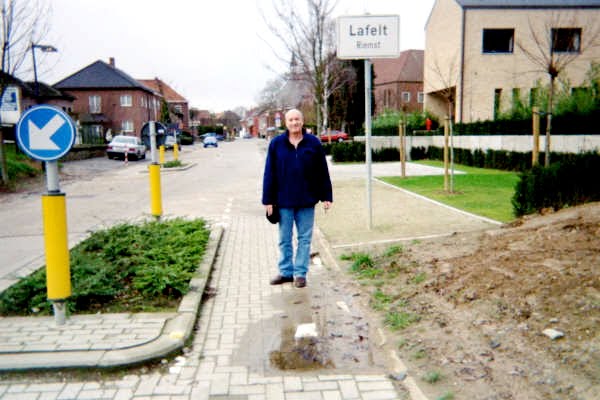
It seems that the current spelling is "Lafelt".  Many accounts have it as "Lauffelt", "Laufeldt", or "Laffelt" or some such variation.  Likewise for the battle of Roucoux; I've seen "Roucou" "Rocoux" and even "Rocourt" in French sources.

Thanks again for sending these, John, and I'm glad to have them up at last!

Saturday, May 15, 2010

Relation de la Campagne en Brabant et en Flandres, MDCCXLVII


I love Google Books, even if (understandably) modern authors who find their works posted therein would probably like to arrange to have a horse's head placed in Sergei Brin's bed on account of copyright violations.

But it is one of the real benefits of the digital revolution that great old books like this one are being put on the Internet.  

Sure, it is in French- a rather archaic French at that- but as far as I am aware, how else can an anglophone reader get hold of a copy of A Relation of the Campaign in Brabant and Flanders in 1747 by Jean-Baptiste Joseph Damarzit de Sahuguet d' Espagnac?

Published in 1748- just a year after the events it describes- the book recounts the Battle of Lauffelt and the taking of Bergen-Op-Zoom.  

Included are maps and, at least for the French army, full orders of battle as well.  What a find!  I've downloaded the PDF file and will steadily work my way through it.

I've half a mind to translate it myself, even if my French is not what it once was.  From what I can tell so far there is some fascinating information to be gleaned here.  

The Imperial Dignity...

One of the commanders of my army of the Pragmatic Sanction, the illustriously named- if obscure- commander of the Imperial contingent.  

This is His Excellency,  Matthias St. Hubertus von Loseth-Pfaffenhofen, Duke of Avenberg-Pfaffenhofen and Landgrave of Nassau Ringworm-auf-dem-Skree. (1679-1753)

He is of course a fictional character, meant as a foil to that other figure of my imagination, the Marquis de Sangfroid.    He is also an ancestor of one of my characters in my Napoleonic Wars project, Herzog Reinhardt Avenberg von Loseth-Pfaffenhofen, Hereditary (and rightful!) Duke of Avenberg-Pfaffenhofen, the dashing leader of the Freikorps von Pfaffenhofen. 

A composition shot I took earlier of the stand for reference.   I use hexagonal bases for senior wing/ army commanders.   

As the Landgrave is somewhat advanced in years (yet tough for his age after many a campaign, and possessing considerable political adroitness and a sharp, quick mind), I decided to use Front Rank's WSS miniature of that most unlucky French general at the Battle of Blenheim, Marshal Tallard.  While the uniform and clothing date from a period forty years prior to the War of the Austrian Succession, I think it reasonable to suggest that the Landgrave is likely to dress in a more conservative style than his younger colleagues.

And I like the figure.  I've had it sitting in my spares box for some time now.  I originally bought it with the idea of mounting it on a block and painting it as a statue for a terrain piece I made, but on seeing it I was amazed at the detail and quality of sculpting.  The thought of covering it in gesso and weathering it to represent aged bronze seemed a waste of a perfectly good and gorgeously cast figure. So I just had to find a way to work him into my army.

The minis in the Front Rank War of the Spanish Succession range are noticeably larger than those from their much earlier SYW/ Jacobite Rebellion ranges that make up most of my WAS collection, but as the Landgrave was renowned for his stature, this is not a problem.

The trumpeter and kettle-drummer are Eureka WAS Dutch cavalry mounted on Front Rank horses.  It's a good combination. While I very much like the Eureka Dutch cavalry, the horses themselves look a little short in the leg for my taste.  I'll probably replace all the cavalry horses with Front Rank ones as they look better in my opinion. 

Why Dutch?  Well, as the ruler of Avenberg-Pfaffenhofen, just inside Austrian territory along the border with Bavaria, the Duke is of course bound to the service the Empress of Austria and to the defence of her Imperial dignity.  Furthermore, in his capacity as Landgrave of Nassau Ringworm-auf-dem-Skree,  he is honour bound to uphold Her Majesty's claim to her lands in the Austrian Netherlands against French territorial aggrandizement.  

In this he shares mutual strategic interests with the Protestant House of Orange, and has on numerous occasions contracted the service of the Dutch Republic for assistance in maintaining the independence of this vulnerable enclave on the Rhine, so close to French territory and that of his traditional rivals, the Bouillon-Cantinats of St. Vignobles.

Right now the command figures are mounted on bottle caps and being painted. When they are finished I'll post pictures here.


Wednesday, May 12, 2010

265 years ago today...

May 11th marks the anniversary of the Battle of Fontenoy, Marshal de Saxe's most famous victory.
Let us quaff a tankard of brandy or a bottle of wine to all who fought and fell on both sides.

*****

I'm shocked to see it's over a year since I last updated the blog.  Time flies much too fast.

Nevertheless, the anniversary seems to make this a good time to take up the digital quill and to  delve into the mid-18th C. world of the Pragmatic army again.  

So in commemoration- and guilt at not keeping this blog more active- tonight I have been working on some Dutch and French for the War of the Austrian Succession.  My "French" commander is finished and can be seen here, but for the Pragmatic Army I'm also working on an Imperial command stand as well as a Dutch artillery crew that are both near completion, with some infantry waiting in the wings.

I'll post some pictures soon, along with some snippets of information I've managed to find over the past year or so.


Sunday, July 26, 2009

Piedmontese!


Lifted this from the pages of TMP.

Amazing miniatures, 30mm, and sorely tempting...

Thursday, June 4, 2009

Time flies...

In the half a year since I updated this blog, this particular moth has been flitting around a number of different hobby porchlights for a while so "Will ye go to Flanders?" has been cruelly neglected of late.

My fascination with the War of the Austrian Succession has never been in danger of waning. However, there is ever only so much time available to spend on one facet of a hobby in which I have a number of different interests and projects on the go. Fortunately, a number of events are happening/ have happened which after such a long absence mean that it is high time for me to be doffing my tricorne again.

First off, and of great importance to me after having first read it all those years ago while a freshman at university, is the arrival of a new edition of Sir Reginald Savory's 1966 masterpiece, His Britannic Majesty's Army in Germany during the Seven Year's War.

This remains the only comprehensive modern book in English on the western campaigns of the Seven Year's War between the French and the Allied armies that I am aware of. After having walked over the battlefield of Bergen (1759) on my last trip to the Frankfurt area, I am anxious to read up on that and other battles of the time again.


It is being reprinted by Nigel Billington, through a very promising publishing venture, the 18th Century Press.

While Nigel and I are both very much into the War of the Austrian Succession ("WASsies" as he terms it!), the SYW is a mere stone's throw away in time, and I will be delighted to have it on my bookshelf at last. Congratulations, Nigel, and thank you for doing such a service for 18th C. aficionados.

Once Nigel notified me that things were ready to roll I had no hesitation in ordering a copy. At 75 pounds Sterling it is not cheap, but is still a good buy, seeing as good condition copies on the second hand market go for up to 4oo pounds or so- as do the reprinted versions by Athena Books.

And now perhaps at last I can finally get over the urge to kick myself for not having pilfered the University of British Columbia's copy when I had the chance; because some else must have done, as when I went back some years later to refer to it it had been long missing!

The other 18th C. goodness due to be shipped off my way is the latest edition of the Koenig Krieg rule set now published by Siege Works Studio in Australia. As I mentioned previously here, this was my first and still my favourite set of rules for gaming 18th C. battles, and while the bulk of the rules have remained "as is" it seems that there have been some revisions with unit sizes and rule presentation as well, with a much more "modern" layout in keeping with what gamers have come to expect lately (the original rules, as well as the second edition put out by Freikorps 15, look so "eighties" these days...).

Finally, I received an email from a well-known designer of board games asking if I had any information on the Allied order of battle for Lauffelt in 1747. Well, that is proving a headache but I may discuss this more on that on a later post.

Saturday, December 27, 2008

Gaming in the Grand Way...

Battle of Malplaquet; Another 9/11 on a vast scale, 300 years ago.


...is evidently alive and kicking in France.

Almost forty years before the War of the Austrian Succession, but these pictures give a great idea of wargaming on a large scale. Would that my games ever end up looking like this!

Malplaquet, 1709. An amazing array of flags on splendid terrain. Check the pictures in the gallery.

Friday, December 26, 2008

Good reading ahead!

Click image to enlarge,
(but buying a copy of the book will be more rewarding!
)

Good news for me on the War of the Austrian Succession front! At long-last I received my copy of Denis Gandilhon's Fontenoy- France Dominating Europe. And what a book it is! Well worth the wait.

Now, I cannot yet attest as to how accurate it is historically (I've only just received it today, after all), but as for first impressions- wow!

Part of the French Histoire & Collections "Men and Battles" series, this book is very much after the model of the familiar Osprey books. Although books like this tend to meet a lot of scepticism these days for a tendency toward inaccuracy or "fluff", they can still certainly inspire, and if you know little or nothing about the Battle of Fontenoy, you could do a lot worse than start here.

One thing I did notice immediately, though, was that the French infantry were shown in coloured waistcoats. While certainly the case in the Seven Years War, in the 1740's most (but not all) French regiments had plain waistcoats the same colour of the justeaucorps. This will not be the only book which has made that same mistake.

Regardless, this book certainly left me wanting to get hold of some more 18th C. miniatures! Eye-candy galore, with 82 pages of text including an order of battle. Each page is illustrated in full colour with maps and pictures. Some are familiar, but many are new to me, including some wonderful shots of re-enactors (Les Soldats du bien-Aimé; you can note the very pale grey- almost white- shade of the French justeau-corps!). Most exciting for me so far are the colour uniform plates, including Dutch infantry and cavalry, although I'd probably double-check my sources before using them as a painting guide.

*****

The other good news is that John Wright was kind enough to send me phots from his trip to the old battlefield of Lauffeldt in Belgium. Great to see them, and I'll be sorting through them and posting the best ones here in the next few days.

Thursday, December 25, 2008

Tweaking the Pragmatic Army (v.2)

click on picture to enlarge

Merry Christmas to everyone out there. Hope it is a good one for all.

The plan for world domination- or at least suzerainty over Flanders- continues for the Army of the Pragmatic Sanction.

As those who know me can attest, I am not a competition gamer and detest tournaments and "rule driven" army lists with matching points.

For one thing, I hate math.

Another thing is that the Gods did not treat everyone so even-handedly in real life out there on the battlefield. Few generals worth their salt would have accepted combat unless they felt reasonably sure that they enjoyed a numerical advantage, or at least some advantage in terrain or supplies. Those that didn't would have had battle forced upon them.

More often than not, the weaker side would retire behind a line of fortresses, where both sides might settle down to a siege and order a fine dinner of venison and claret (after having first arranged for the courtesans to attend them in their camps) until either first one side would pitch tents and return home as winter approached, or the other side would surrender the fortress after asking for- and receiving- the honours of war. Rinse and repeat for the next campaign season.

Still, there are some benefits is having a point system so that initial forces can at least be comparable with one another. After that, and once armies march of to war, things break down, mistakes are made, orders are misunderstood, ignored, or even lost, and roads become impassable. Bluebear Jeff mentioned one of my favourite tabletop devices for ensuring some unexpected "friction", namely dicing for appearance.

Just how many points I'm dealing with here for Koenig Krieg I need to work out, but Drew on the KK forum suggested that I'm looking at about 1500 points or so. At some point in the future I'll provide a detailed list of the units involved with their stats for use with KK.

*****

I've been tweaking the composition of the army list a little as more snippets of info arise.

First off, it turns out that there was a mixed Anglo-Austrian Brigade at The Battle of Dettingen, so it stays!

Secondly, I have reconsidered my artillery "doctrine". According to the Koenig Krieg lists, one army (heavy) gun may be allotted per brigade. So I've decided to do them after all- in large part after seeing some nicely painted batteries in an old issue of Miniature Wargames that was done by the League of Augsburg club. These were basically mini-dioramas of heavy guns in action in the Nine-Years War in the 1690's.

I realized that something along the same lines for the War of the Austrian Succession would be fun to do! So, I've added four guns to my target- one each of Austrians, Dutch, British and Hanoverians. The bases won't be quite as big as the one that Phil created, but they will allow me scope for modelling some little extra bits and pieces. Maybe 60-80mm wide by 100mm deep. Just so long as I use the same basing with M. de Saxe's merry men, it should be no problem.

Thirdly, my old bugaboo the Dutch horse. They are always proving themselves to be enigmatic, to say the least. "Seneffe" in his comment on my post on Dutch Cavalry mentions that Dutch Dragoons could be big regiments, with Schlippenbach's being up to seven(!) squadrons strong.

Things are made complicated by the fact that the army list for the United Provinces that were in the old edition of the Koenig Krieg rules that I have were clearly based on the reorganized post-WAS Dutch army, so are of no help to me at all. That leaves me with just a few pages on Dutch cavalry in the booklet by Stephen Manley with which to work things out, so Seneffe's help, and that of others, is warmly appreciated.

Anyway, I may therefore opt for 16-figure instead of 12-figure regiments, but only if I like painting them! I always feel that fielding understrength regiments is always justifiable anyway, as outpost duty, hangovers and glandular fever take their steady toll on numbers.

Finally, we turn to "The Quality"- army commanders. I have included three, not that they will all be in command at the same time. As with all alliances, there was plenty of friction between the different commanders, given touchy caste pride and as a result of frequent contradictory instructions-and pressure- from their respective governments. Not to mention just plain, simple good 'ol incompetence and bloody-mindedness due to gout. There seems to be plenty of opportunities for a "game within a game" to see if subordinates actually "do as they're dam' well told, damn their eyes, man!" As I'll likely be solo-gaming, this could make the games a lot more interesting.

And if that seems too harsh on the Pragmatic Alliance, just wait until you see my thoughts on the French army with its boudoir politics and petty jealousies! I'm sure I'll be able to level the playing field. I'm working on an order of battle for the French side now as well, which will appear later this week on my (long-too-inactive) "les Reves des Mars" site.

Wednesday, December 24, 2008

The Grand Plan

click on image for bigger picture

...for my Pragmatic army. This is a long-term goal of course, but it think it may be practical in Koenig Krieg terms. Two brigades of Dutch infantry, one Hanoverian, and a mixed Austrian/British brigade. It is somewhat tentative, as I do need to check the cavalry and artillery strengths.

Cavalry will consist of a brigade of Dutch Horse, one of Austrians (including a regiment of some brigand-like hussars), and one of Hanoverian horse. Cavalry will make up about a third of the army, which may be a little high. I may reduce it by cutting out one of the Austrian dragoon regiments, especially I find myself getting tired of painting horseflesh!

Army artillery is generic at this stage. British? I haven't really found out much about the artillery of the Pragmatic Army yet. Every infantry brigade will have a light gun in addition to the heavy battery. I suspect heavy artillery was not all that mobile in 1747, if at all.

The army represented here is taken from a hodgepodge of orders of battle from the WAS, including Dettingen and Fontenoy. It is a good representative force rather than being a snapshot of any particular battle, and I'm happy with that.

I've no idea right now how this works out in terms of point values for KK, but in honesty that is not really a concern to me. I've always gone the historical order-of-battle route. The French opposition will be of similar, if not identical, strength which is all that matters.

And the graphics for the orbat were fun to do. I've become quite proficient at PowerPoint and iPhoto these days.

Right, now back to cleaning the flash of those figures! I've a busy evening glueing tails up equine derrières ahead of me...

Kapitain's Log, supplemental-

"musket99" one of the brains behind the new Koenig Krieg project from Siege Works Studios, was kind enough to give me some feedback on the list. He raised the point that there is likely too much artillery for a force this size, so out with the heavies! That saves time and money my end, so no complaints there.

His other issue is whether there was in fact a mixed Anglo-Allied brigade. I got this information from my source giving an order of battle for Dettingen, and I did have to wonder myself whether such a joint command would have been feasible given any doctrinal differences between the two armies- not to mention the language barrier! The source I have mentions the following single-batallion units as being brigaded under Count Salm at the Battle of Dettingen in 1743.
  • 37th Regt. of Foot (Ponsonby's)
  • 23rd Regt. of Foot (Peer's)
  • No. 60- Arenberg (Austrian)
  • No. 62- Heister (Austrian)
Does anyone out there have an alternative organization for these regiments? If so, I'd love to know! It may be that I might have to split the brigade in two, and add another couple of batallions or so to each depending on what comes to light.

Thanks to musket99 for pointing this out to me! Once I get some firm infomation on this, I'll update the chart again.


Tuesday, December 23, 2008

Getting down to brass tacks...

Christmas is coming, the prezzies are wrapped and under the tree, and the sushi has been ordered for Christmas dinner.

My birthday falls on Christmas Eve, so this year my wife bought me a set of bookshelves for my hobby room. Bless her, as this is quite a big step forward for me. It means that I have been able to clear the painting table of assorted flotsam and jetsam, and now actually have room for painting again!


"Happy birthday to me, La LA la DEE dee..."

With all that out of the way, it leaves me just under four weeks of vacation time left for painting, and if I am to accomplish anything at all, I need a firm plan. So here it is!

I first intend to finish up some odds-and-ends; units of French and Russian Napoleonics that have been hanging around in a state of almost-there-but-not-quite for longer than I care to admit, and a re-basing of some ACW minis I've had stashed away in boxes for some years now.

But my main project will be to begin work on my Eureka WAS Dutch army. Here is the first instalment, four 12-figure units of infantry with a regiment of dragoons and a battalion gun, as well as a brigadier and His Excellency, The Prince of Waldeck-Pyrmont (lurking at rear on the hexagonal base; no doubt riding around in a state of chronic indecision, like a chicken with its head cut off).

All are based for Koenig Krieg (the new version of which should be coming out early in the new year).


Step 1 will be to to clean the flash from the buggers (I hate- really hate- that part of the hobby), and then get them all primed and mounted on plastic bottle caps for painting.


My goal is to get at least two of the infantry battalions- Broenkhoorst's and Broekhuysen's regiments- painted by the third week of January, along with the attached battalion gun, and to have made at least 50% progress on the others including the cavalry.

Here are the cavalry.


I really like these fellows. They have a lot of character, including some minor head variations. Modelled at ease- clearly just waiting for the order to slash through French ranks- they have that requisite 18th C. "stateliness", and the officer in particular is a real haughty looking chap.

There are a few odd spots; the horses are maybe a tad small, but not significantly so, and the minis match up pretty well with the Front Rank cavalry I have for the French. Most noticeable to me was a large lump that passes for the butt of the carbine. This could be filed down, but for the sake of time I am not going to bother as it does not really detract from the look of the unit. Unusually, the tails of the horses are separate and have to be glued on. This it makes for cleaner casting of the horses and less time with the file. On the whole, I am extremely satisfied with these guys and look forward to painting them.

Most likely they will be the Hessen-Homburg dragoons.

So it is out with the files and hobby knives, put on a CD, and just get down to work. Wish me luck!


Tuesday, December 16, 2008

Pandours at Pfaffenhofen?

My ongoing search for any concrete information on the Battle of Pfaffenhofen has not been terribly fruitful, but I did come across this blog -in German- which deals briefly with the battle. Now my German skills are right up there with my Serbo-Croat and Arabic (i.e. pretty-nigh zilch), and running it through Babelfish produced a load of what was pretty much gibberish.

Still, I was able to determine that those dreaded irregular troops from the Balkans, Baron Trenck's Pandours may have been present, merrily wreaking havoc as they went, and that the Austrians rolled up the right of the Franco-Bavarian line. Pfaffendorf itself was seized by 200 dragoons.


BaronTrenck is an interesting character in his own right, as you may read here. Wouldn't want to meet him or his men lurking on a dark night while using the ATM machine.

Saturday, December 13, 2008

Pfontenoy!

After looking at Pfaffenhofen, a pfamous battle pfor a change!

I just got word from Amazon that this one is now winging its way to Tokyo. Good timing, for as of Dec. 20th I'll be starting a four-week vacation. Four weeks for painting and reading!


Thursday, December 11, 2008

A Pfight at Pfaffenhofen!

The protagonists...


Now you may well be asking yourselves; "Pfaffen-who? Wasn't she on John McCain's campaign team?"

Which is what I first thought after coming across- quite by chance- a reference to this 1745 battle between the Austrians under Karl Josef Batthyány on one side, and the Bavarians, French and Hessians led by a French General, Henri François de Ségur on the other.

This seems to be an intriguing engagement in many respects.
  • First of all, this was a major victory with remarkable strategic consequence- it had the effect of knocking the Bavarians out of the war completely.
  • Secondly, you had a Franco-Bavarian army with Hessian allies- we usually think of Hessians being allied against the French in the 18th C., so here is a chance for an army with a difference! On the Austrian side, it features derring-do by the hussars and pandours (Croats?)
  • Next, it fulfils my interest in obscure battles- and I mean obscure; I have found very little on the battle at all, let alone any detailed order of battle. You can read about it here, and it represents the sum total of what I know about the engagement.
  • Finally, one just has to love that name- Pfaffenhofen!

References are tantalizingly few. Even the revered Christopher Duffy glosses it over in his The Army of Maria Theresa. Reed Browning does have this to say about the campaign and battle;

"In April 1745 Austria celebrated a glorious triumph. Vienna had responded to the accession of Max Joseph [the new Elector of Bavaria] in Munich by offering both peace and a restoration of territory to the young elector.

Count Seckendorff urged Max Joseph to accept; Count Törring urged him to resist.
[Seckendorff was a Bavarian minister and Törring a general]. The elector hesitated between the two camps, immobile and hence at war. Maria Theresa finally lost patience and authorized the application of pressure: "it is not to be doubted that...Bavaria will be brought to peaceloving thoughts all the more quickly"

On 21 March 1745, Batthyány launched a blitzkrieg, assisted by Bernklau and Browne [both Austrian generals]. All the Bavarian garrisions in the east fled, Törring's army sat divided and paralyzed, and the French army under Count Ségur engaged Batthyány at Pfaffenhofen only to lose. Max Joseph abandoned Munich for the imperial city of Augsburg, and Batthyany marched his army to the edge of the capital."

Reed Browning,
The War of the Austrian Succession
p. 203

And that is about it! Not exactly teeming with information, considering that Bavaria and Austria would, as a result of the ensuing Treaty of Füssen (made possible by Batthyány's victory) bury the hatchet until Napoleonic times.

If anyone out there has any more information on this enigmatic campaign that they'd be willing to share, please let do me know! I've exhausted my "Google-foo", and I doubt I'll find out much about it any public libraries here in Tokyo!


Saturday, December 6, 2008

"Our 'ero..."


Bluebear Jeff reminded me that it is about high time that I updated this blog, and I concur! I have been keeping busy on a number of hobby fronts- working on some WAS Dutch here, some French infantry (1742 and 1813 varieties) there, with some ACW stuff on the side for variety (a number of Union infantry that just need some touching up & re-basing). This time of year always has a lot of demands on my time, but I've been trying to get in at least a few hours every week of painting time.

And what better way to celebrate the coming holiday season than with a concert of music celebrating- wait for it- a victory for the otherwise fairly hapless Duke of Cumberland!

My wife and I are off to the opera here in Tokyo tomorrow. We are both baroque music lovers, and when we saw that the Bach Collegium Japan- an internationally-acclaimed group specializing in music of the Baroque era- were putting on Handel's oratorio, Judas Maccabeus, it was a no brainer- get out that 'ol plastic banker and book the tickets!

Judas Maccabeus is nominally the story of the famous Jewish leader of the revolt against the Seleucids back in ancient times, but in fact it was composed in honour of "Butcher" Billy Cumberland's waxing of the Jacobites at Culloden (the clansmen seemed to have been easier pickings than were the French under M. de Saxe).

It includes the famous tune "Hail the Glorious Hero". Toe-tapping fun, which should get the juices flowing, and a new CD to listen to while I paint!


A week ago I received the balance of my order from Eureka Miniatures- cavalry and artillery. I'm so far very impressed with them. Gorgeous castings indeed. I've already started cleaning them up and will prime them this week. Wish I had some decent information on flags for the Dutch horse and dragoons, though.

December is always a pretty hectic time of year, but I've got a full four weeks holiday coming up, from the middle of the month; I expect to get a lot of projects finished then. My wife is an accountant, and what with her company's fiscal year coming to an end in January, she will be out of the way- sorry, I mean busy (ahem)- for much of the time I am on vacation, so it is a great time for me just to chill out and to paint until my fingers are worn down to the knuckles!


Thursday, November 13, 2008

Deadlier than the Male...

Bland's Dragoons at Dettingen. Women's work, apparently...

Long
time since I updated any of my blogs. Things have been busy yet again, what with work, other family obligations and until recently "election fever" (in both Canada and the US, and probably sometime soon in Japan- I'm something of a political junkie).

I have also been trying to reduce eyestrain by not spending any more time on the computer than necessary! Still, I have had the opportunity to get in at least a little painting time, so the hobby hasn't been completely dormant for me.

Anyway, Let me atone for the silence with something for Remembrance Day. While surfing through Google Books, I came across Mary Ralphson, redoubtable trooper of dragoons- quite an amazing story actually. We're not looking at a character from a Jane Austen novel here! More like someone who has stepped out from the pages of Sterne's Tristram Shandy or from one of those Rowlandson etchings of 18th C. life.

To have been able to have survived childhood illnesses, poor food and bloody battles, and not to have shuffled off the mortal coil until the age of 110, meant that you just had to have been made of sterner stuff than other mortals!

Read on...


THE SCOTS MAGAZINE, AND EDINBURGH Literary MISCELLANY:
Being a GENERAL REPOSITORY OF LITERATURE, HISTORY, AND POLITICS

FOR 1809.


Ne quidfalsi dlcere audeat, ne quid veri non audeaí.

VOL. LXXI.

EDINBURGH

Mary Ralphson, whose maiden name was Cameron, was born in the neighbourhood of the old castle of Inverlochy, once a royal residence, near Fort William, in the parish of Kilmanivaig, in the dreary district of Lochaber, Inverness-shire, on the 1st of January 1698, O. S. Early in life she married Ralph Ralphson, a private dragoon*.

On the war breaking out in French Flanders, in 1741, she embarked with her husband, and shared in the toils and vicissitudes of the troops, whom she afterwards accompanied in the battle of Dettingen, June 15, 1743 (OS).

In this engagement (fought by the British and French, the former commanded by George II. and the brave Earl of Stair, and the latter by Marshal Noailles,) being on the field during the heat of the conflict, and surrounded with heaps of slain, she observed a wounded dragoon fall by her side. (She) disguised herself in his clothes, mounted his charger, and regained the retreating army, in which she found her husband.

She was also present at the unfortunate affair of Fontenoy, May 1st, 1745, fought by the British and Austrians, under William, Duke of Cumberland, against the French, under Marshal Count de Saxe.

When the rebellion broke out in Scotland, in September 1745, Mrs Ralphson accompanied her husband to Britain, his regiment being among those sent to the north on that occasion. In this expedition she was present at the skirmish at Clifton, near Penrith, where the highlanders sustained some loss. On the 17th of January 1740, she was present at the defeat of the royal army at Falklrk, under Gen. Hawiey. In April, same year, she was present at the defeat of the highland army, by the Duke of Cumberland, at Culloden, near Inverness.

When the rebellion was quelled at home, Mrs Ralphson again went to the continent with the British army, and was present at the battle of La Val**. Sometime after this she lost her husband, in which period she bid adieu to the fatigues of the army, and settled in Liverpool, where she subsisted for seven of the latter years of her life, by the assistance of some benevolent characters, chiefly female, who contributes every thing to her comfort and accommodation.

She died on Monday, June 27, 1809, having arrived at the very advanced age of 110 years and 6 months, and was interred in the burying ground of the Scotch kirk, Oldhara Street, where a stone with a suitable inscription points out the resting place of the remains of this venerable person.

p.570


* Apparently in Bland's (3rd) Regt. of Dragoons.
** AKA the Battle of Lauffeldt


Sunday, October 19, 2008

Dutch courage!

Two contemporary- and quite favourable- references to the morale and performance of the Dutch army at the Battle of Roucoux in letters from a Mr. R. Leveson-Gower, to the Duke of Bedford in 1746. They were written 232 years ago almost to the day.

I searched the net for information on the Leveson-Gower family of the time. Possibly- but I'm not certain- it may have been the young Richard Leveson-Gower, born 1726, died 1753. MP for Lichfield 1747-53. He seems to have been the only member of the family whose name starts with an "R", and who was of an age to have been closely involved in the events of the time. ("I say, Holmes, how do you do it?!) Leveson-Gower appears to have been resident in The Hague at that time, but whether in any official capacity or as a private citizen I've no idea.

One can detect a certain amount of optimistic "spin" here, but the praise for the Dutch seems sincere enough. And those casualty figures are just frightful- they alone speak for some no small degree of determination. The original text can be found here.

In later letters, he is less enthusiastic about the surrender by the Dutch of important border fortresses- but surrendering a fortress prematurely sounds to me more likely to be a failure of will on the part of the garrison commander rather than of his men.

******

MR. LEVESON GOWER TO THE DUKE OF BEDFORD.

Hague, October 14. 1746. N. S.

My Lord Duke,

I am extremely concerned that I am to send your Grace such bad news as that of a battle in Flanders to our great disadvantage. (Battle of Roucoux, Oct. 11th 1746)

On Tuesday 1746 last the French, as is supposed, either designing to set down before Maestricht, or to draw off the allied army from this part of the world to straiten them in their winter quarters, attacked the left of our army, composed of the troops in our pay and the Dutch, who, although they behaved with great resolution and bravery, were forced to retire behind the right wing composed of the Austrians, leaving behind them some cannon and two pair of colours.


The reason why the Austrians did not engage is, that had they gone to the assistance of the left the French would have gained their point in cutting off the communication with this country and besieging Maestricht, which they cannot do at present, as our army is now encamped under the cannon of that place. The number of the killed and wounded of our side is reckoned here from 1000 to 4000, though I send a letter from the French army to-day that said the allies left behind them but 1200. All the letters from both armies agree that the loss of the French is much more considerable, as a body of nine Hanoverian battalions defended a village against an infinite number of the enemy for four hours, which place they could not have forced but by pouring in every minute fresh supplies.

Two Bavarian regiments that arrived there but two days before are entirely ruined, as likewise two Hessian battalions, of which they say there remains but one captain and fifty private men. The Dutch behaved incomparably well, insomuch that they lost many of their officers, and some of their best regiments are almost ruined.

Of our troops I hear of but two battalions engaged, which some say are taken prisoners. Colonel Montague is said to be killed, Major Noble taken, and poor Sir Harry Nesbitt shot through the body. I have heard nothing particular of the killed and wounded of the French side. The Marquis de Fenelon, who was formerly ambassador here, is killed. I hear that Prince Waldeck, who is greatly blamed, treats this affair in his account as a thing of no great consequence.


What I here send your Grace is what I could pick up from the best hands, and what I believe you will find at present the most authentic.

I am, &c.

R. LEVESON GOWER


******


MR. LEVESON GOWER TO THE DUKE OF BEDFORD.


Hague, October 18. 1746. N. S.

My Lord Duke,

Your Grace will find that this affair in Flanders will not turn out so much to our disadvantage. The Dutch take it very much to heart, and the reputation their troops have got by their good behaviour makes them very uppish.

The French here, who one would imagine to be very insolent upon it, are quite the contrary : whether it proceeds from the effects they see his affair has upon the people here, or from the attack Mr. Lestock (Admiral Richard Lestock) has made upon the coasts of Britany, I can't say ; but the fact is true, and there is not one of them that says a word.

The loss of the Dutch by the muster since the action amounts to 1768 killed, wounded, and missing,
and that of the troops in our pay to about the same number. The French have lost twice as many, so that they have no good reason to be very well pleased. They have since retired to their old camp at Tongres, and have begun to detach for Italy with twenty battalions and twenty squadrons.

If the King of Sardinia and the Austrians are in earnest, their detachments won't end there. Mr. Lestock (who every body supposes has done them great mischief, since they have stopt all letters) will I hope force them to detach too, and then I fancy our negotiations at Breda will have a good face, which is the sincere wish of,

R. LEVESON GOWER.

John Russell, 4th Duke of Bedford

Looking at Leveson-Gower's first letter and his remarks on Prince Waldeck's reported reaction to the tidy drubbing that the Pragmatic Army received at Marshal de Saxe's able hands, the Prince clearly had that modern-day politician's gift for denial in the face of contradictory reality!

I also note a reference to two Bavarian regiments that formed part of the Pragmatic Army. Clearly some research is in order, as Bavarians can usually be counted upon to provide a splash of colour in any wargaming army!


Culloden Moor

The Jacobite Rebellion- culminating in the Battle of Culloden Moor- cannot be separated from the larger struggle that was the War of the Austrian Succession. Certainly Marshal de Saxe and King Louis XV benefitted from having the bulk of the British army in Flanders being sent back to the British Isles to deal with the uprising. Arguably the defeat of the Stuart cause was obtained at the cost of failure in the low countries.

I found this link on YouTube showing clips from Peter Watkin's 1964 BBC documentary of the battle. Forty years on it is still an impressive and moving account.

You will find little in the way of Lace War "chivalry" here, though. This was civil war at its nastiest.