Saturday, May 22, 2010

The visitor's centre at Lauffelt, and a cliffhanger...


Two items today.  

First is this interesting link on a recently new visitor centre for the Battle of Lauffelt.  It's a Dutch site from 2008 featuring the composer of the soundtrack used in the centre.  Scroll down a bit and there is an English version of the text.  

The MP3 has Dutch, French, English and German commentary in that order, so listen to the whole thing! 

Diagram of the visitor centre at Lauffelt  from the website

I think I can definitely say that the next time I find myself in Europe I'm going to be putting a visit to Lafelt/ Lauffelt on the itinerary. 

Oh, and to complicate matters even further, I discovered that the Battle of Lauffelt was also known as the Battle of Val.  While battles can often be known by more than one name, I wonder how many others have such a severe identity crisis to deal with as does, apparently, the Battle of Lauffelt.

*****

The second item I'm going to leave as a bit of a cliffhanger.

I'm sure we've all had that experience of searching the Internet for information one one subject only to be sidetracked by another, related snippet of information that holds our attention.

Well, this happened to me last week.  Not related directly to the War of the Austrian Succession, but the person in question was indeed contemporary to it.   I was looking for information on a certain artist- who is probably well known to anyone with an interest in 18th C. military history- and while doing so came across this.  

Warning, while only a sketch it is rather gruesome.

Now I'm no ghoul, but neither am I particularly squeamish.  My father was a policeman; he had many books on forensic medicine in the house, and as I was an inveterate snoop when it came to books, I soon got used to seeing this kind of thing.   

But this picture fascinated me because of who it was, when and how he died, the circumstance in which the drawing was made, and the subsequent fate of his remains. 

The story may not be new to others out there, but it is the first time I have heard of it.  If anyone does know, or if someone wants to hazard a guess to who the subject of the drawing may be, the battle in which he fell,  and the artist, feel free to comment. 

All shall be revealed in due course, and I'll post more information and some links in a few days time. 

Suffice to say for now that he was one of those people of his time who evidently lived life to the full.

Sunday, May 16, 2010

John Wright's Lauffelt pictures


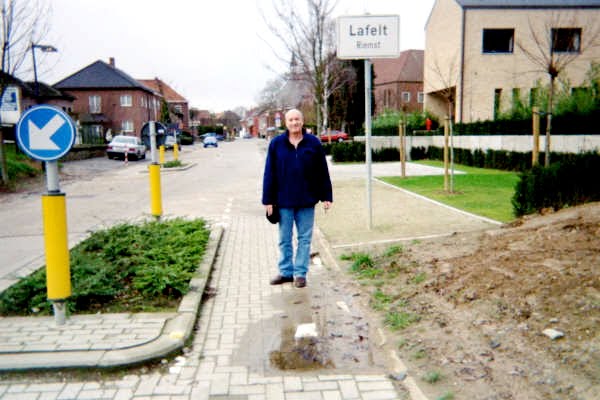
Well over a year ago now, John Wright was kind enough to send me his photos of a trip he made to Belgium and to the battlefield of Lauffeldt, fought in 1747.

I intended to post them here, but got distracted by "real life" for a number of months.  When later I went to find them,   I couldn't find the folder anywhere on my computer.  Well, I finally came across them a few weeks ago when cleaning my gaming room; I'd put them on a CD-ROM and placed it in a binder of magazine articles on 18th C. wargaming for safe keeping.  Too safe, apparently.  At least finding the photos were a big reason in my deciding to get back to work on updating this blog!

My apologies to John if you are reading this, but here they are.  I have brightened up the photos on iPhoto, and I must say they are quite atmospheric.


Talk about cavalry country; no wonder Ligonier was able to shine while covering the retreat.  And while relatively flat ground, it is clear that there are rises and dips in the ground that could cover movement, especially when you consider that the whole field of battle would have been covered by a considerable amount of smoke from burnt powder.

Here is a contemporary map of the battlefield.

click to enlarge

John can be seen here standing next to the memorial for the Irish Brigade in French service.  The campaign in Flanders really was their finest hour.  Here is a close up of the inscription on the memorial.
 

One of the "joys" of researching this period is that names could be spelt in as many ways as there were people spelling them!  


It seems that the current spelling is "Lafelt".  Many accounts have it as "Lauffelt", "Laufeldt", or "Laffelt" or some such variation.  Likewise for the battle of Roucoux; I've seen "Roucou" "Rocoux" and even "Rocourt" in French sources.

Thanks again for sending these, John, and I'm glad to have them up at last!

Saturday, May 15, 2010

Relation de la Campagne en Brabant et en Flandres, MDCCXLVII


I love Google Books, even if (understandably) modern authors who find their works posted therein would probably like to arrange to have a horse's head placed in Sergei Brin's bed on account of copyright violations.

But it is one of the real benefits of the digital revolution that great old books like this one are being put on the Internet.  

Sure, it is in French- a rather archaic French at that- but as far as I am aware, how else can an anglophone reader get hold of a copy of A Relation of the Campaign in Brabant and Flanders in 1747 by Jean-Baptiste Joseph Damarzit de Sahuguet d' Espagnac?

Published in 1748- just a year after the events it describes- the book recounts the Battle of Lauffelt and the taking of Bergen-Op-Zoom.  

Included are maps and, at least for the French army, full orders of battle as well.  What a find!  I've downloaded the PDF file and will steadily work my way through it.

I've half a mind to translate it myself, even if my French is not what it once was.  From what I can tell so far there is some fascinating information to be gleaned here.  

The Imperial Dignity...

One of the commanders of my army of the Pragmatic Sanction, the illustriously named- if obscure- commander of the Imperial contingent.  

This is His Excellency,  Matthias St. Hubertus von Loseth-Pfaffenhofen, Duke of Avenberg-Pfaffenhofen and Landgrave of Nassau Ringworm-auf-dem-Skree. (1679-1753)

He is of course a fictional character, meant as a foil to that other figure of my imagination, the Marquis de Sangfroid.    He is also an ancestor of one of my characters in my Napoleonic Wars project, Herzog Reinhardt Avenberg von Loseth-Pfaffenhofen, Hereditary (and rightful!) Duke of Avenberg-Pfaffenhofen, the dashing leader of the Freikorps von Pfaffenhofen. 

A composition shot I took earlier of the stand for reference.   I use hexagonal bases for senior wing/ army commanders.   

As the Landgrave is somewhat advanced in years (yet tough for his age after many a campaign, and possessing considerable political adroitness and a sharp, quick mind), I decided to use Front Rank's WSS miniature of that most unlucky French general at the Battle of Blenheim, Marshal Tallard.  While the uniform and clothing date from a period forty years prior to the War of the Austrian Succession, I think it reasonable to suggest that the Landgrave is likely to dress in a more conservative style than his younger colleagues.

And I like the figure.  I've had it sitting in my spares box for some time now.  I originally bought it with the idea of mounting it on a block and painting it as a statue for a terrain piece I made, but on seeing it I was amazed at the detail and quality of sculpting.  The thought of covering it in gesso and weathering it to represent aged bronze seemed a waste of a perfectly good and gorgeously cast figure. So I just had to find a way to work him into my army.

The minis in the Front Rank War of the Spanish Succession range are noticeably larger than those from their much earlier SYW/ Jacobite Rebellion ranges that make up most of my WAS collection, but as the Landgrave was renowned for his stature, this is not a problem.

The trumpeter and kettle-drummer are Eureka WAS Dutch cavalry mounted on Front Rank horses.  It's a good combination. While I very much like the Eureka Dutch cavalry, the horses themselves look a little short in the leg for my taste.  I'll probably replace all the cavalry horses with Front Rank ones as they look better in my opinion. 

Why Dutch?  Well, as the ruler of Avenberg-Pfaffenhofen, just inside Austrian territory along the border with Bavaria, the Duke is of course bound to the service the Empress of Austria and to the defence of her Imperial dignity.  Furthermore, in his capacity as Landgrave of Nassau Ringworm-auf-dem-Skree,  he is honour bound to uphold Her Majesty's claim to her lands in the Austrian Netherlands against French territorial aggrandizement.  

In this he shares mutual strategic interests with the Protestant House of Orange, and has on numerous occasions contracted the service of the Dutch Republic for assistance in maintaining the independence of this vulnerable enclave on the Rhine, so close to French territory and that of his traditional rivals, the Bouillon-Cantinats of St. Vignobles.

Right now the command figures are mounted on bottle caps and being painted. When they are finished I'll post pictures here.


Wednesday, May 12, 2010

265 years ago today...

May 11th marks the anniversary of the Battle of Fontenoy, Marshal de Saxe's most famous victory.
Let us quaff a tankard of brandy or a bottle of wine to all who fought and fell on both sides.

*****

I'm shocked to see it's over a year since I last updated the blog.  Time flies much too fast.

Nevertheless, the anniversary seems to make this a good time to take up the digital quill and to  delve into the mid-18th C. world of the Pragmatic army again.  

So in commemoration- and guilt at not keeping this blog more active- tonight I have been working on some Dutch and French for the War of the Austrian Succession.  My "French" commander is finished and can be seen here, but for the Pragmatic Army I'm also working on an Imperial command stand as well as a Dutch artillery crew that are both near completion, with some infantry waiting in the wings.

I'll post some pictures soon, along with some snippets of information I've managed to find over the past year or so.


Sunday, July 26, 2009

Piedmontese!


Lifted this from the pages of TMP.

Amazing miniatures, 30mm, and sorely tempting...

Thursday, June 4, 2009

Time flies...

In the half a year since I updated this blog, this particular moth has been flitting around a number of different hobby porchlights for a while so "Will ye go to Flanders?" has been cruelly neglected of late.

My fascination with the War of the Austrian Succession has never been in danger of waning. However, there is ever only so much time available to spend on one facet of a hobby in which I have a number of different interests and projects on the go. Fortunately, a number of events are happening/ have happened which after such a long absence mean that it is high time for me to be doffing my tricorne again.

First off, and of great importance to me after having first read it all those years ago while a freshman at university, is the arrival of a new edition of Sir Reginald Savory's 1966 masterpiece, His Britannic Majesty's Army in Germany during the Seven Year's War.

This remains the only comprehensive modern book in English on the western campaigns of the Seven Year's War between the French and the Allied armies that I am aware of. After having walked over the battlefield of Bergen (1759) on my last trip to the Frankfurt area, I am anxious to read up on that and other battles of the time again.


It is being reprinted by Nigel Billington, through a very promising publishing venture, the 18th Century Press.

While Nigel and I are both very much into the War of the Austrian Succession ("WASsies" as he terms it!), the SYW is a mere stone's throw away in time, and I will be delighted to have it on my bookshelf at last. Congratulations, Nigel, and thank you for doing such a service for 18th C. aficionados.

Once Nigel notified me that things were ready to roll I had no hesitation in ordering a copy. At 75 pounds Sterling it is not cheap, but is still a good buy, seeing as good condition copies on the second hand market go for up to 4oo pounds or so- as do the reprinted versions by Athena Books.

And now perhaps at last I can finally get over the urge to kick myself for not having pilfered the University of British Columbia's copy when I had the chance; because some else must have done, as when I went back some years later to refer to it it had been long missing!

The other 18th C. goodness due to be shipped off my way is the latest edition of the Koenig Krieg rule set now published by Siege Works Studio in Australia. As I mentioned previously here, this was my first and still my favourite set of rules for gaming 18th C. battles, and while the bulk of the rules have remained "as is" it seems that there have been some revisions with unit sizes and rule presentation as well, with a much more "modern" layout in keeping with what gamers have come to expect lately (the original rules, as well as the second edition put out by Freikorps 15, look so "eighties" these days...).

Finally, I received an email from a well-known designer of board games asking if I had any information on the Allied order of battle for Lauffelt in 1747. Well, that is proving a headache but I may discuss this more on that on a later post.