Sunday, October 19, 2008

Dutch courage!

Two contemporary- and quite favourable- references to the morale and performance of the Dutch army at the Battle of Roucoux in letters from a Mr. R. Leveson-Gower, to the Duke of Bedford in 1746. They were written 232 years ago almost to the day.

I searched the net for information on the Leveson-Gower family of the time. Possibly- but I'm not certain- it may have been the young Richard Leveson-Gower, born 1726, died 1753. MP for Lichfield 1747-53. He seems to have been the only member of the family whose name starts with an "R", and who was of an age to have been closely involved in the events of the time. ("I say, Holmes, how do you do it?!) Leveson-Gower appears to have been resident in The Hague at that time, but whether in any official capacity or as a private citizen I've no idea.

One can detect a certain amount of optimistic "spin" here, but the praise for the Dutch seems sincere enough. And those casualty figures are just frightful- they alone speak for some no small degree of determination. The original text can be found here.

In later letters, he is less enthusiastic about the surrender by the Dutch of important border fortresses- but surrendering a fortress prematurely sounds to me more likely to be a failure of will on the part of the garrison commander rather than of his men.

******

MR. LEVESON GOWER TO THE DUKE OF BEDFORD.

Hague, October 14. 1746. N. S.

My Lord Duke,

I am extremely concerned that I am to send your Grace such bad news as that of a battle in Flanders to our great disadvantage. (Battle of Roucoux, Oct. 11th 1746)

On Tuesday 1746 last the French, as is supposed, either designing to set down before Maestricht, or to draw off the allied army from this part of the world to straiten them in their winter quarters, attacked the left of our army, composed of the troops in our pay and the Dutch, who, although they behaved with great resolution and bravery, were forced to retire behind the right wing composed of the Austrians, leaving behind them some cannon and two pair of colours.


The reason why the Austrians did not engage is, that had they gone to the assistance of the left the French would have gained their point in cutting off the communication with this country and besieging Maestricht, which they cannot do at present, as our army is now encamped under the cannon of that place. The number of the killed and wounded of our side is reckoned here from 1000 to 4000, though I send a letter from the French army to-day that said the allies left behind them but 1200. All the letters from both armies agree that the loss of the French is much more considerable, as a body of nine Hanoverian battalions defended a village against an infinite number of the enemy for four hours, which place they could not have forced but by pouring in every minute fresh supplies.

Two Bavarian regiments that arrived there but two days before are entirely ruined, as likewise two Hessian battalions, of which they say there remains but one captain and fifty private men. The Dutch behaved incomparably well, insomuch that they lost many of their officers, and some of their best regiments are almost ruined.

Of our troops I hear of but two battalions engaged, which some say are taken prisoners. Colonel Montague is said to be killed, Major Noble taken, and poor Sir Harry Nesbitt shot through the body. I have heard nothing particular of the killed and wounded of the French side. The Marquis de Fenelon, who was formerly ambassador here, is killed. I hear that Prince Waldeck, who is greatly blamed, treats this affair in his account as a thing of no great consequence.


What I here send your Grace is what I could pick up from the best hands, and what I believe you will find at present the most authentic.

I am, &c.

R. LEVESON GOWER


******


MR. LEVESON GOWER TO THE DUKE OF BEDFORD.


Hague, October 18. 1746. N. S.

My Lord Duke,

Your Grace will find that this affair in Flanders will not turn out so much to our disadvantage. The Dutch take it very much to heart, and the reputation their troops have got by their good behaviour makes them very uppish.

The French here, who one would imagine to be very insolent upon it, are quite the contrary : whether it proceeds from the effects they see his affair has upon the people here, or from the attack Mr. Lestock (Admiral Richard Lestock) has made upon the coasts of Britany, I can't say ; but the fact is true, and there is not one of them that says a word.

The loss of the Dutch by the muster since the action amounts to 1768 killed, wounded, and missing,
and that of the troops in our pay to about the same number. The French have lost twice as many, so that they have no good reason to be very well pleased. They have since retired to their old camp at Tongres, and have begun to detach for Italy with twenty battalions and twenty squadrons.

If the King of Sardinia and the Austrians are in earnest, their detachments won't end there. Mr. Lestock (who every body supposes has done them great mischief, since they have stopt all letters) will I hope force them to detach too, and then I fancy our negotiations at Breda will have a good face, which is the sincere wish of,

R. LEVESON GOWER.

John Russell, 4th Duke of Bedford

Looking at Leveson-Gower's first letter and his remarks on Prince Waldeck's reported reaction to the tidy drubbing that the Pragmatic Army received at Marshal de Saxe's able hands, the Prince clearly had that modern-day politician's gift for denial in the face of contradictory reality!

I also note a reference to two Bavarian regiments that formed part of the Pragmatic Army. Clearly some research is in order, as Bavarians can usually be counted upon to provide a splash of colour in any wargaming army!


Culloden Moor

The Jacobite Rebellion- culminating in the Battle of Culloden Moor- cannot be separated from the larger struggle that was the War of the Austrian Succession. Certainly Marshal de Saxe and King Louis XV benefitted from having the bulk of the British army in Flanders being sent back to the British Isles to deal with the uprising. Arguably the defeat of the Stuart cause was obtained at the cost of failure in the low countries.

I found this link on YouTube showing clips from Peter Watkin's 1964 BBC documentary of the battle. Forty years on it is still an impressive and moving account.

You will find little in the way of Lace War "chivalry" here, though. This was civil war at its nastiest.

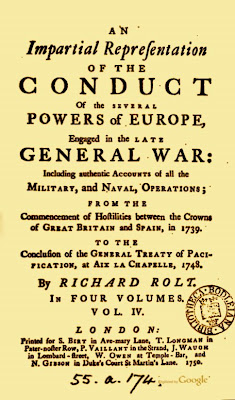
"An impartial representation of the conduct of the several powers of Europe" -Richard Rolt

Click on image to access the book on the Goggle Books site
(you can download the PDF fil
e there)

While looking through the excellent Google Books site, I was very pleased to stumble across this contemporary account- printed in 1750- of the War of the Austrian Succession, penned by someone named Richard Rolt.

In 1750 the conflict had not long been over, and Rolt refers to it as "The Late General War"- obviously the name by which we call the war now was not then universally known.

Once you get used to the different spelling conventions (for example, the printers convention where an "f" stands in for "s") and to its more complex syntactical structure, it provides a fascinating account of the conflict seen through contemporary eyes just two years after the Treaty of Aix-la-Chappelle, and six years before the start of the SYW.

Saturday, October 18, 2008

"Blutige Rückseiten"

Not a lot of blogging time for me recently. Work has been keeping me pretty busy at the computer, and the last thing I've been wanting to do when I got home was to spend even more time gazing at a monitor!

I have been able to get in some painting time- which should trump blogging anyway if I am to make any progress on the heaps of lead and pewter that I have stacked around the house.

But I have no intention of seeing my blog go dormant, so while I work on my French and Dutch, here is the plan for the Hanoverian infantry brigade. I will be recruiting these fine fellows from Front Rank.

click on the picture for a bigger view

Monroy's Brigade was present with the Army of the Pragmatic Sanction at the Battle of Dettingen in 1743. It consisted of the following regiments;
  • Zastrow (SYW No. 1B Alt-Zastrow)
  • Monroy (SYW No. 4B von Stolzenberg)
  • Middacten (SYW No.5A von Grote)
  • Böselager (SYW No. 7A von Wangenheim)
  • Sommerfeld (SYW No. 10A von Post)
I already have two stark-naked metal battalions already lying around and taunting me with their (unfinished) presence, but I will not be working much if at all on the Hanoverians until I have at least two other brigades painted and based (I really need to get working on increasing my collection of French). Still, it's good to have a plan.

Sunday, October 12, 2008

More Dutch from Eureka

On this thread on TMP, "Der Alte Fritz" asked for more pictures of the new War of the Austrian Succession Dutch range from Eureka. So for our favorite Prussian monarch here in cyberspace, here are some more.

From left to right: grenadier, grenadier drummer, officer with spontoon, mounted colonel, line drummer (rear view), and sergeant with halberd.

I don't have any cavalry or artillery yet- they'll be coming next month.

Saturday, October 11, 2008

Roucoux Day!

Today marks the 232nd anniversary of the Battle of Roucoux. I shall mark it by starting work on my Dutch infantry.

By way of commemoration, here's something about the preeminent hero on the Allied side, General John, Earl Ligonier, the energetic commander of the British cavalry. He seems to have had the unenviable role of being left to pull what remained of the charred chestnuts out of the fires started by the unfortunate Duke of Cumberland.

John, Earl Ligonier

John Ligonier, second son of Monseuquet, a gentleman of a noble Huguenot family, was born in France in the year 1687. He received his education in England; and, having a strong predilection for a military life acted, when only fifteen years of age, as a volunteer, at the storming of Liege, on which occasion, he was one of the two first who mounted the breach: his companion, a volunteer, of the noble family of Wentworth, was killed by his side.

In 1703, having purchased the command of a company in Lord North’s regiment, he fought at the battles of Schellenburgh
(sic) and Blenheim; in the latter of which, every captain in the regiment was slain except himself. In 1706, he obtained the rank of major of brigade, for his daring exploits at the siege of Menin. At Ramillies, Oudenarde and Wynendale, he gained additional laurels; and at Malplaquet, twenty-two shots went through his clothes without wounding him. In 1719, he assisted, as colonel and adjutant-general, at the attack made by Lord Cobham on Vigo; and, after the capture of Ponte Vedra, reduced Fort Marin, at the head of only a hundred grenadiers, although it contained twenty pieces of cannon, and a garrison of two-hundred men.

During the war which commenced in 1739, Ligonier repeatedly distinguished himself. After the battle of Dettingen, in which his regiment had severely suffered he received the honour of knighthood, under the royal standard. At Fontenoy, where he commanded the infantry, he reluctantly complied with the Duke of Cumberland’s orders to retreat, and before he left the field, sent to the enemy’s commander, Marshal Saxe, requesting that the dead might be treated with honour, and the wounded with humanity. In 1746, he was appointed to the chief command of the forces in Flanders.

At Roucoux, after sustaining an impetuous onset, he effected so masterly a retreat as to excite the admiration of his opponent. At the battle of Laffeldt in 1747, he rescued the allied army from destruction, and enabled it to withdraw in good order, by charging at the whole line of French cavalry at the head of the British Dragoons.

His horse having been killed, he fell into the enemy’s hands; but his parole was immediately accepted and Marshal Saxe observed, on introducing him to the French king, “Sir, I present to your majesty a man, who by one glorious action, has disconcerted all my projects”. The monarch, who had witnessed the action from an eminence, warmly applauded the gallantry of Lignier, who was soon after exchanged, and resumed his command.


In 1748, though still in Flanders, without having made any application to the electors he became Member of Parliament for Bath. During the same year he was appointed lieutenant-governor of the island of Guernsey; and in 1752, governor of Plymouth. In 1757, he became an Irish peer by the title of Viscount Ligonier of Enniskellen; in 1763, an English baron; and three years afterwards, an English earl.

At the time of his decease, which occurred on the 28th of April, 1770, he was a field-marshal of the royal forces, a privy counsellor, colonel of the first regiment of the foot-guards, K.C.B and F.R.S. Soon after his death, a monument was erected in Westminster abbey, recording the various actions in which he had taken part.


Lord Ligonier acquired renown throughout Europe for the intrepidity which he displayed against his own countrymen. His abilities, as general, were quite equal to his courage. In the midst of difficulties he was never without resources; and his talents were always most conspicuous when exerted to avoid an impending disaster, or to alleviate the consequences of a defeat.

In private life, as in his public career, he frequently carried his point by some peculiar expedient. A military visitor from whose troublesome presence it was exceedingly difficult, by any of the usual hints, to obtain relief, Ligonier, on one occasion, dismissed in a moment, by beginning, with his fingers, to beat a retreat on the wainscot.

The Georgian Era
(Author unrecorded)
London, 1833
p. 45

Friday, October 10, 2008

Eureka! They're here! (updated)

Back view- what the gamer sees as his brave boys go into the attack!
From left, Minden, Eureka, Front Rank.

The Dutch infantry from Eureka, that is. And they are really- really- nice! I'm quite pleased with them.

Here is a photo teaser- I'll update this post tomorrow with a review comparing them with other miniatures available for the War of the Austrian Succession. Let's just say for now that each range is a contender for some quite different reasons.

On the left, French infantryman from Minden Miniatures.
In the middle, the one of the new W.A.S. Dutch infantry from Eureka.
On the right, a French infantryman from Front Rank.

Now I have to say that I like all three ranges for different reasons. They all have their strengths and weaknesses (but Eureka seems to embody the best of the other two). Posing is excellent with all three in my opinion- the Eureka and Minden minis in particular capture the staid pace we associate with the soldiery of the time.

As far as posing goes, we are a far cry from Old Glory offerings here- thank heavens!

The first thing I noticed when placed alongside the Front Rank and Minden Miniatures offerings was that the Eureka miniatures are big! True 28mm from soles of the feet to the eyes. In height, the Eureka model is a very close match to the Minden figure. Both tower a fair bit over their Front Rank equivalent. To be fair to Front Rank, their SYW range was early on the scene and when they first saw the light of day, they were larger than most other ranges out there.

We all know that prices generally tend to rise over time. The same seems to apply to the height of our toy soldiers. New releases of miniatures nominally the same size tend to get only larger as the years go by. Must be due to changing diets.

Because of the height- and style- differences, I wouldn't mix these within the same units. However, combining figures from all these manufactures to represent your armies on the table top would not pose much of a problem as the differences are not too pronounced. I'll be happy to have units made up from all three manufacturers on my table.

No problem with the Dutch, mind you- there are no other alternatives out there to mix with them!

Moving on the the "heft" of the figure, it is clear to see that the Eureka mini is much more slender than Front Rank's, which looks decidedly chunky in comparison (again, though, bear in mind that the SYW are relatively old releases for Front Rank- many of their more recent releases in their Napoleonic/ Marlburian ranges are much taller and much less "rotund").

Eureka's Dutchman is, however, somewhat beefier than the Minden model. All three pretty much push Dixon's SYW figures off the radar!

Interestingly, the muskets of the Eureka and Front Rank samples are of much the same length- the one on the Minden chap is quite long and slender- closer to the original without a doubt.

Note the head and tricorn sizes- the ones on the Eureka and Front Rank minis are quite robust- and this is where I have my reservations about the Minden miniatures.

The detail on the Minden is very fine, and the proportions are overall quite natural. But I have problems with those heads on two grounds:
  1. I am not sure that my painting style suits the small faces, which are much more like 1/72 scale plastic figures. Fine works of art, but I can't help thinking that to do justice to the casting, the faces call for a time-consuming and subtle painting approach to bring out the best in them. Personally, I prefer the larger "canvas" offered by the Front Rank mini. I'm okay with the Eureka model, which has a face which while slender, is "big" enough for me to use my current painting style easily.
  2. Personally, I think that the Minden head is too small. This is not to say that it is not properly proportioned- it may well be so- but it just looks too small for me, especially when viewed at any distance. This isn't helped by the sloping shoulders, which seem to accentuate this and which for me make the minis look somewhat too 'lethargic". I think the more square-shouldered look of the Eureka and Front Rank models come out best here, especially when in closely-packed ranks on their bases.
I'd like to comment on this a bit, as it seems to come up a lot in discussions on miniatures, especially with 18th C. ranges for some reason. The trend seems to moving from the "chunky, caricatured end of the scale- think Foundry, earlier Front Rank offerings and Crusader- towards more slender minis such as the older RSM range, Minden, The Perry twins, Alban Miniatures, and now Eureka.

On the whole, I think this a nice change, but I do have some reservations. One is that I believe we are dealing with representational art here, not with scale models. The figures may look "realistic" on an individual basis, but when placed in units of 12-16 or even 24 figures as I am doing, I realize that some other visual dynamic is at play. I can't quite put my finger on it, but to me figures need some degree of exaggeration in sculpting-call it artistic license- for them to establish a visual "presence" on the tabletop when viewed from two or three feet away if they are to stand out. What works when looking at one miniature in the palm of your hand may not work when looking at a number of them in units on the tabletop. This is as true of painting as it is of sculpting and posing.

Another issue- as Bluebear Jeff will appreciate- is ease of painting!

Regardless of how detailed, well-proportioned or accurate a miniature is, it will only look as good as it is painted. I feel that a chunky miniature with the wrong shaped cartridge box or grenadier cap will, if attractively painted and based, result in a much better impression overall than a well-proportioned and accurate scaled-down version of the prototype but which has been given a slap-dash paint job. For example, exaggerated raised straps are usually much easier and quicker to do than more subtly-sculpted ones, and if that translated into a more neatly-painted unit then it may well be an overall plus.

Enough meandering for now. I need to get to the workbench, remove flash, get some priming /painting done and report my findings! Stay tuned.

Side view; Minden, Eureka, Front Rank.
Clearly our Dutch infantrymen has a strict sergeant- he knows how to "stand up straight, Damn yer eyes!!!"